


Café Academy:
The Barista's Essential Skills
An interactive, gamified learning experience that helps new baristas master recipes, POS navigation, and customization handling under real-world café conditions. Designed as a memory-building, speed-training simulation using Articulate Storyline 360 for performance tracking and adaptive feedback.
.png)
Audience: New Baristas
Responsibilities: Instructional Design, Front-End Analysis, Needs Assessment, Scenario Writing, Visual Development, Digital Illustration
Tools Used: Articulate Storyline 360, Adobe Fresco, Canva, ChatGPT, Artlist, ElevenLabs, Google Suite


The Problem
Newly hired baristas at Nami Roasters’ expansion locations were underperforming compared to staff at the original store. Sales at new sites lagged, and customer satisfaction scores dropped noticebly.
Analysis revealed a key issue: baristas lacked structured opportunities to practice recipe memorization and build fluency. Core challenges included:
-
Long wait times exceeding 15 minutes during peak hours.
-
Inconsistent drink quality across locations.
These deficiencies resulted in slower throughput, reduced repeat business, and a measurable decline in revenue.
The Solution
I developed a gamified interactive skill-building training program replicating real café pressures. It requiries baristas to take and enter orders, recall recipes, and craft drinks accurately under timed conditions.
This solution was:


Claritying: Transformed complex drink standards and POS navigation into repeatable workflows to practice until it became second nature.
Innovative: Instead of static manuals, it used interactive simulations, timed drills, and real-time feedback to build speed and consistency.
Immersive: Learners trained in a virtual café mirroring their actual workspace, complete with order queues, customer prompts, and performance meters that recreated the pace and pressure of a live shift.



My Process

I followed a structured, evidence-based approach that aligned with the ADDIE framework:
-
Front-End Analysis (FEA) confirmed performance gaps stemmed from training deficiencies and identified root cause.
-
Needs Assessment defined performance goals through a learner, context, and gap analysis.
-
Playable Prototype to validate pacing, realism, and user engagement.
-
Content Map organized learning objectives and practice activities to ensure full content alignment.
-
Iteration & Feedback to refine flow, timing, and difficulty balance.
Needs Assessment
I conducted a theoretical Front-End Analysis that confirmed declining sales at new Nami Roasters locations stemmed from inconsistent barista performance caused by insufficient practice-based training.
Using the Five Whys framework, I traced the issue to training that both overlooked practical industry knowledge and lacked structured repetition.
The Training Charter established a clear goal: reduce wait times to under 15 minutes and increase sales by 40% through a gamified simulation that builds recipe fluency, POS accuracy, and customization speed.

The Needs Assessment defined key learner and environmental constraints: baristas aged 16–25, training in noisy backrooms on shared tablets with no LMS. This meant the learners required short, self-paced modules that are tablet-friendly.
The Task Analysis distilled the work into four core skills: (1) Recipe recall, (2) POS navigation, (3) Customization accuracy, and (4) Customer terminology. From these, I built Learning Objectives tied to measurable outcomes, such as entering orders correctly and crafting drinks to standard within timed conditions.

Content Map
As part of the project’s design concept, I outlined a Content Map to illustrate how the simulation would align with subject matter expertise and ensure comprehensive content coverage if implemented.
In a live project, this map would be reviewed with SMEs alongside the playable prototype to verify that:
-
All recipe types, drink variations, and customizations are represented.
-
POS menu paths mirror the actual system flow.
-
Practice activities progress logically from guided repetition to timed performance.
-
Feedback and scoring reflect realistic store expectations.
This stage conceptually demonstrates how SME collaboration could validate scope and sequencing. Ensuring that every performance behavior practiced in the prototype aligns with real-world operational goals.
Playable Prototype
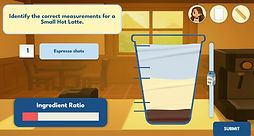
I built a playable prototype in Articulate Storyline 360 to demonstrate how the training could function in practice, as well as test the flow of interactions before full development.
Features:
-
Timed POS simulation replicating real menu paths.
-
Recipe drills with instant correctness feedback.
-
Speed and accuracy scoring with progress tracking.
-
“Rush hour” challenges adjusting difficulty based on comprehension progression.
Testing: The prototype was evaluated for pacing, realism, and user engagement by sample learners.
_edited.jpg)
_edited.jpg)
_edited.jpg)
Visual Mockups
Inspired by some of my favorite cozy games, such as Animal Crossing and Cooking Mama, I began the visual design process by curating a mood board that blended cozy, familiar aesthetics with functional realism.
Using Adobe Fresco, I hand-illustrated all characters and built multiple expression sets tied to learner actions to reinforce emotional feedback during the simulation.
Soft lighting, warm wood tones, and approachable 3D-style props were used to reduce cognitive load and create an inviting atmosphere that makes performance-based training engaging and approachable.
I also created a style guide in Canva using Nami Roasters’ brand colors to ensure visual consistency across all elements, balancing the company’s aesthetic with a soothing, approachable tone through clean sans-serif fonts and sophisticated character sets.


Full Development
Using feedback from the playable prototype, I developed the final concept in Articulate Storyline 360, assembling the content and visual assets into a cohesive learning experience.
Each section functions as a mini-game, allowing baristas to practice recipe recall, POS navigation, and customization handling in short, replayable bursts. All of the sections are connected through a central menu-based interface for easy navigation.
The result is an interactive, gamified skill-building simulation that transforms repetitive skill practice into an engaging series of challenges that build confidence and fluency.

Results and Takeaways
Although the project remains a prototype, it demonstrates a replicable model for improving service consistency and reducing ramp-up time in quick-service training.
If implemented, outcomes would include:
-
Faster onboarding: Learners reach operational confidence sooner through guided repetition and feedback.
-
Improved consistency: Standardized recipes, faster POS entry, and reduced order errors.
-
Sustained performance: Supplementary job aids such as (quick-reference recipe cards) support retention beyond initial training.
This project reframes barista onboarding as a skill-building simulation that strengthens confidence through muscle memory. With more time, future iterations would include pre- and post-assessments to measure learner growth and program effectiveness.
True mastery isn’t taught—it’s practiced. When employees are given space to learn by doing, they deliver results that last.